

Reports


Hydrate for Health have commissioned or are featured in a number of reports which may be of interest.
- Nursing Times - Improving the hydration of hospital patients
-
Featured in Nursing Times in October 2011
A hands-free drinks system can help to reduce patient dehydration in acute settings. This article covers:
- Why dehydration is a problem in acute care
- Conducting an audit of a hands-free drinks system
- How the system can help maintain fluid balance
To read the full report, please download it here: Nursing Times Feature – Improving the hydration of hospital patients
- Nursing Times - Dehydration: why is it still a problem?
-
Featured in Nursing Times in June 2011
The effects of dehydration and why prevention is not as straightforward as it seems. This article covers:
- The physical and financial consequences of dehydration
- Identifying and diagnosing dehydration in older people
- Useful strategies to prevent the occurrence of dehydration
To read the full report, please download it here: Nursing Times Feature – Dehydration: why is it still a problem
- Nursing Times - Does hands-free drinking improve patient dehydration?
-
Featured in Nursing Times in July 2013
A hands-free bottle has been designed to improve hydration in hospital patients. Qualitative data showed it was more acceptable to certain groups of patients. This article covers:
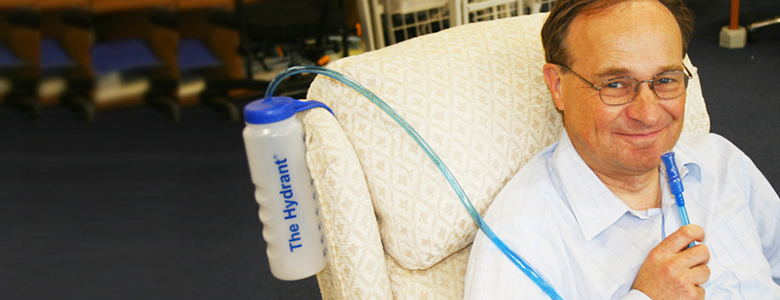
- What is the Hydrant?
- Evaluation of the device
- Patient and staff opinions on the device
To read the full report, please download it here: Nursing Times Feature – Does hands-free drinking improve patient hydration?
- The Hydrant at Stoke Mandeville Hospital
-
The Hydrant at Stoke Mandeville Hospital
Author: Liz Evans, Clinical Nurse Specialist, Nutrition
In 2008, I attended a nutrition conference at the Royal College of Nursing. There were many stands there, all with excellent products to help with patient care. However, the stand that predominantly drew my interest was the Hydrant. It appeared to be an incredibly simple concept.
A bottle with a straw attached that could be used by patients with reduced mobility to ensure that they received adequate hydration. Mark Moran, the inventor, had come up with the idea when he was in hospital recovering from a spinal operation, and had difficulty accessing water.
To read the full report, please download it here: The Hydrant at Stoke Mandeville Hospital
- The Hydrant at Lister Hospital, Stevenage
-
The Hydrant Project – Promoting good hydration at East and North Hertfordshire NHS Trust
East and North Hertfordshire Trust have been piloting the use of The Hydrant drinking system on four ward areas over a two-month period. The project aims were to ascertain whether:
-
Dehydration could be managed or avoided in patients using the hydrant drinking system
-
To assess as to whether The Hydrant could assist in reducing infection rates
-
To assess whether The Hydrant is an effective delivery method of drinking fluid for patients
- To assess whether The Hydrant could assist in the reduction of time patients spent in hospital
To read the full report, please download it here: The Hydrant at Lister Hospital , Stevenage
-
- The Hydrant at GWH Swindon (interim report)
-
Hydrant Project – 27th January 2012
Authors: Karen Braid, Project Lead, Clinical Productive Team; Zara Norman, Sister, Jupiter Ward; Emma Smith, Senior Programme Office Analyst
The pilot of the Hydrant on Jupiter ward has been received positively by patients. There is a strong perception from patients and staff alike that it improves patient hydration. The success is based on a small sample of patients for a limited timescale. Greater validation of its benefits would be obtained through expanding to other patient groups and for a greater timescale.
To read the full report, please download it here: The Hydrant at GWH Swindon (interim report)
- The Hydrant at GWH Swindon (final report)
-
Hydrant Project – 24th October 2012
Authors: Karen Braid, Project Lead Productive Ward; Emma Smith, Senior Programme Office Analyst
The pilot of the Hydrant on Jupiter ward has been running since October 2011 and continues to be received positively by patients. There is a strong perception from patients and staff alike that the use of the Hydrant improves patient hydration.
Further data analysis on the affect of patient conditions and pharmaceutical drug usage has been obtained to understand the benefits of the Hydrant and this indicates that there has been a positive impact for patients staying on Jupiter ward.
The Trust will be participating in the National Hydrant programme, the project is managed by Hydrate for Health in Partnership with the Department of Health and the NHS.
To read the full report, please download it here: The Hydrant at GWH Swindon (final report)
- The Hydrant at Medway NHS (final report)
-
In partnership with Medway NHS Foundation Trust
Dehydration occurs when the body loses fluids at a greater rate than it takes in. For some patients, achieving a fluid balance without assistance is difficult and they rely on relatives or health professionals to help them.
The Trust has taken part in the National Hydrant Programme. The project has been managed nationally by Hydrate for Health, in partnership with the Department of Health and the National Health Service.
To read the full report, please download it here: Medway NHS Hydrant final report.

Winners of The Queen's Award for Enterprise Innovation 2013
